
Affiliate - Ad (I refuse to polute any of my sites with ad widgets that make a site unusable. I created this block so it can be easily ignored if you want) | |
 | Hello! If you’re looking for an easier way to invest, Acorns is a great way to do it. Join with me on your investment journey and you will get a free $5 investment! As a perk of referring you, I can get a reward too. Learn more and see terms here. |
 | The Milli-Spinner: Tiny Stanford device that shrinks dangerous blood clots by up to 95% | |
Milli-Spinner: Revolutionary Technology for Blood Clot Removal
The milli-spinner is a groundbreaking catheter-delivered medical device developed by researchers at Stanford University. It dramatically improves the success of mechanical thrombectomy (clot removal) by densifying blood clots rather than fragmenting them, reducing clot volume by up to 95%.
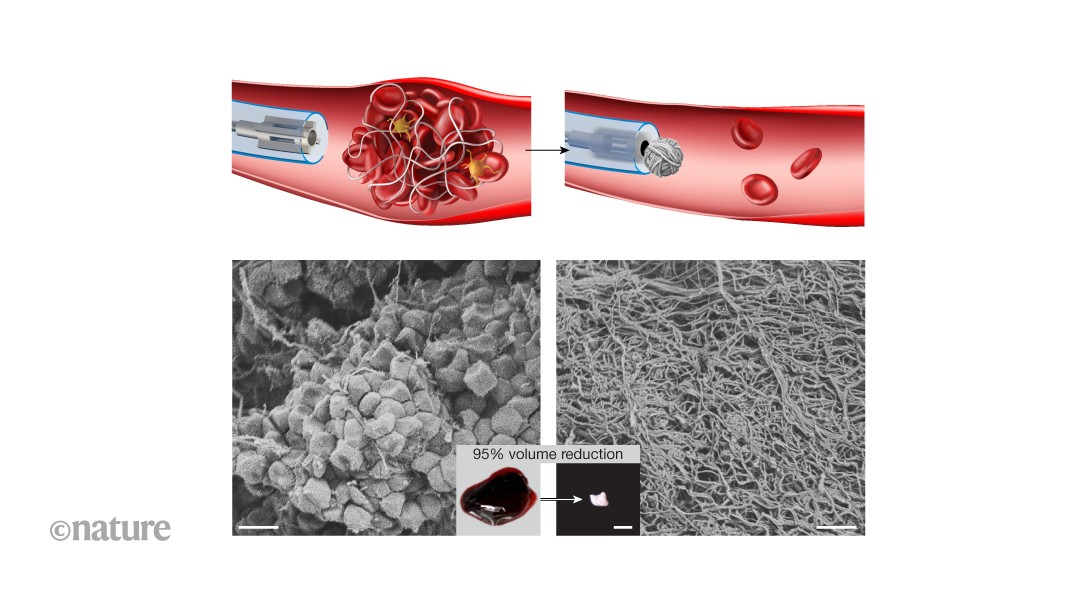
Illustration showing the milli-spinner densifying a fibrin-rich clot and releasing red blood cells (Nature).
What Is the Milli-Spinner?
The milli-spinner is a small, hollow tubular device (typically 1.2–2.5 mm in outer diameter) featuring fins and slits near its tip. Delivered via a standard catheter, it spins rapidly (thousands of RPM) to generate localized suction and shear forces that compress and reorganize the fibrin network within a blood clot.
Unlike traditional methods that try to aspirate or mechanically grab and pull clots (which often fail on large or fibrin-rich clots and can cause dangerous fragmentation), the milli-spinner densifies the clot in place. Researchers compare the process to “rubbing a cotton ball to reduce its volume.”
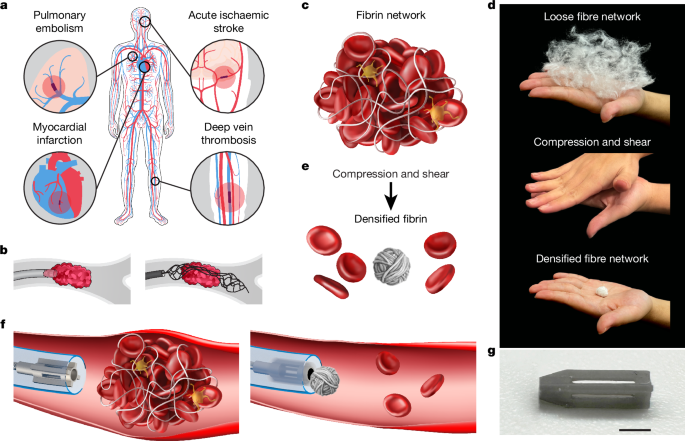
Overview of the milli-spinner mechanism and applications (from the Nature paper).
How It Works
- Delivery: The device is advanced through a catheter to the site of the clot under imaging guidance.
- Localized Suction: Rapid spinning creates strong, highly localized suction that presses the clot against the spinning tip.
- Compression + Shear: Combined forces densify the fibrin fiber network while expelling trapped red blood cells.
- Volume Reduction: Clot volume can shrink by up to 95% (sometimes to as little as 5% of original size) in seconds to minutes.
- Removal: The remaining compact fibrin core is easily aspirated or retrieved through the catheter with minimal risk of distal emboli.
Development and Key Researchers
The technology was developed in the laboratory of Ruike Renee Zhao (Assistant Professor of Mechanical Engineering at Stanford) in collaboration with clinical experts including Jeremy J. Heit (Chief of Neuroimaging and Neurointervention at Stanford). Other key contributors include Yilong Chang, Shuai Wu, Qi Li, Benjamin Pulli, and others from Stanford Engineering and Medicine.
The discovery originated partly from work on magnetic millirobots. Researchers noticed that the strong localized suction generated by spinning devices could interact usefully with clots.
Primary Publication: “Milli-spinner thrombectomy” by Chang et al., published in Nature (Volume 642, pages 336–342) on June 4, 2025.
Zhao Lab research page: Milli-spinner Medical Devices
Performance Results (Preclinical)
- Volume reduction: Up to 95% (often >70–90% even on tough fibrin-rich clots).
- Speed: Significant debulking in seconds to under 2 minutes; some pure fibrin clots densified in ~10 seconds.
- First-pass success: ~90% on difficult fibrin-rich clots (vs. ~11% with existing devices in comparable testing). Overall first-pass reperfusion more than doubled in many models.
- In vitro: Excellent results in pulmonary and cerebral artery flow models (including >500 successful removals in cerebral models in some reports).
- In vivo (swine): High-fidelity revascularization in renal and maxillary arteries, significantly outperforming pure aspiration. Restored meaningful flow on first try in ~90% of cases in some metrics.
The device works across a wide range of clot compositions (RBC-rich to fibrin-rich) and sizes.
Magnetic Milli-Spinner Variant
Researchers have also developed an untethered magnetic milli-spinner robot. Actuated by external rotating magnetic fields, it features a hollow cylindrical body with helical fins, side slits, and a central through-hole.
- Achieves record speeds for untethered magnetic robots in tubes: up to 55 cm/s (~175 body lengths/s) in optimized designs.
- Capable of upstream swimming against physiological blood flows.
- Potential for navigation in highly tortuous vessels, clot debulking, targeted drug delivery, and aneurysm treatment.
Related preprint: Magnetic Milli-spinner for Robotic Endovascular Surgery (Wu et al., 2024).
Potential Applications
- Acute ischemic stroke
- Pulmonary embolism
- Myocardial infarction (heart attack) related clots
- Peripheral artery/vein thrombosis
- Exploratory: Kidney stone fragment removal (related spinner technology)
Commercialization and Status
A Stanford-licensed spin-out company, Spinna Medical, Inc. (Menlo Park, CA), has been formed. Trademarks for “MILLI-SPINNER” and “MILLISPINNER” have been filed with the USPTO for medical devices used in treating blood clots and mechanical thrombectomy procedures (applications filed September 2025; Notice of Allowance issued in 2026).
Current status (as of late 2025/early 2026): Strong preclinical data in flow models and large-animal studies. Human clinical trials are the next major milestone. Experts describe the technology as potentially transformative if results translate to humans.
Further Reading & Media
- Nature paper: Milli-spinner thrombectomy
- Nature Research Briefing: Tiny rotating device puts a new spin on blood-clot removal
- Fortune: A scientific breakthrough researchers call ‘magic’
- CNN video feature
- Zhao Lab – Milli-spinner page
- Medical Xpress coverage
References
- Chang, Y. et al. Milli-spinner thrombectomy. Nature 642, 336–342 (2025). https://doi.org/10.1038/s41586-025-09049-0
- Martini, E. Milli-spinner promises faster and safer blood clot removal. Nat Cardiovasc Res 4, 792 (2025). https://doi.org/10.1038/s44161-025-00690-6
- Wu, S. et al. Magnetic Milli-spinner for Robotic Endovascular Surgery. arXiv:2410.21112 (2024). https://arxiv.org/abs/2410.21112
- Zhao Lab, Stanford University. Milli-spinner Medical Devices. zhaolab.stanford.edu
Information compiled from peer-reviewed publications, Stanford University sources, and major media coverage as of late 2025/early 2026. The milli-spinner remains investigational pending human clinical trials. This is not medical advice.